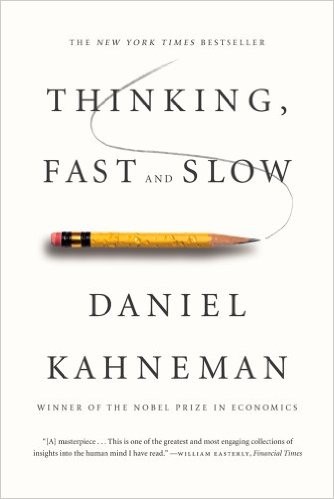
Thinking, Fast and Slow
by Daniel Kahneman
What this book is, and who it's for
Daniel Kahneman's 2011 career-summary volume distills four decades of research that won him the Nobel Prize in Economics — research that almost single-handedly created the field of behavioral economics. The two-system frame (System 1: fast, automatic, error-prone; System 2: slow, effortful, lazy) is now lingua franca for talking about decisions. The book is long and dense in spots but rewards the patience: every cognitive bias popularized in the last decade is in here, with the experiment that demonstrated it. Read this once and you'll recognize your own thinking errors in real time — which is the first step toward not making them.
How to read this book. Each chapter below is a ~30-second summary — the core insight, no filler. Open the chapters that grab you. If the book resonates, buy the full edition on Amazon (link at bottom). Affiliate-disclosed, geo-redirected to your local Amazon (amazon.nl, amazon.de, amazon.co.uk, etc.).
Chapters
- Chapter 1The Characters of the Story0.5 min
- Chapter 2Attention and Effort0.5 min
- Chapter 3The Lazy Controller0.5 min
- Chapter 4The Associative Machine0.5 min
- Chapter 5Cognitive Ease0.5 min
- Chapter 6Norms, Surprises, and Causes0.5 min
- Chapter 7A Machine for Jumping to Conclusions0.5 min
- Chapter 8How Judgments Happen0.5 min
- Chapter 9Answering an Easier Question0.5 min
- Chapter 10The Law of Small Numbers0.5 min
- Chapter 11Anchors0.5 min
- Chapter 12The Science of Availability0.5 min
- Chapter 13Availability, Emotion, and Risk0.5 min
- Chapter 14Tom W’s Specialty0.5 min
- Chapter 15Linda: Less is More0.5 min
- Chapter 16Causes Trump Statistics0.5 min
- Chapter 17Regression to the Mean0.5 min
- Chapter 18Taming Intuitive Predictions0.5 min
- Chapter 19The Illusion of Understanding0.5 min
- Chapter 20The Illusion of Validity0.5 min
- Chapter 21Intuitions Vs. Formulas0.5 min
- Chapter 22Expert Intuition: When Can We Trust It?0.5 min
- Chapter 23The Outside View0.5 min
- Chapter 24The Engine of Capitalism0.5 min
- Chapter 25Bernoulli’s Errors0.5 min
- Chapter 26Prospect Theory0.5 min
- Chapter 27The Endowment Effect0.5 min
- Chapter 28Bad Events0.5 min
- Chapter 29The Fourfold Pattern0.5 min
- Chapter 30Rare Events0.5 min
- Chapter 31Risk Policies0.5 min
- Chapter 32Keeping Score0.5 min
- Chapter 33Reversals0.5 min
- Chapter 34Frames and Reality0.5 min
- Chapter 35Two Selves0.5 min
- Chapter 36Life as a Story0.5 min
- Chapter 37Experienced Well-Being0.5 min
- Chapter 38Thinking About Life2 min
Thinking, Fast and Slow pairs well with
A single book is an argument. A stack is a curriculum. Thinking, Fast and Slow appears in this curated reading path — each pairs it with 3 other books that sharpen its ideas, in a suggested reading order.
From Read Stacks · Learn
How to get more out of this book
Two short essays on the meta-skill — what chapter summaries actually preserve, and the six retention techniques that decide whether what you read here is still useful six months from now.
- Are book summaries actually useful, or am I just cheating?
Chapter summaries are a navigation tool, not a substitute. Used right, they help you read more books fully — by helping you avoid the wrong ones. Used wrong, they're a comfort blanket that lets you feel like you're reading without engaging with the material.
6 min read
- I read a lot of books but can't remember anything. What works?
Forgetting most of what you read is normal, not a personal failing — your brain wasn't designed to retain prose at the rate modern readers consume it. The practices that DO work share one thing: they force you to USE the material instead of just consuming it. Six specific techniques, each tested across decades.
7 min read
Want one curated stack a week in your inbox? Subscribe to the free weekly stack →