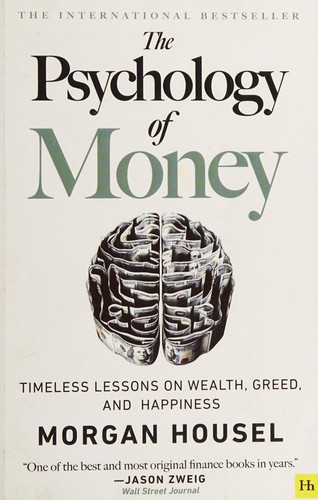
The Psychology of Money
by Morgan Housel
What this book is, and who it's for
Morgan Housel's 2020 book is the rare personal-finance book whose argument is mostly psychological. Twenty short essays make a single case: financial outcomes are determined less by intelligence and more by behavior — and behavior is determined by the stories you carry about money from childhood, peer groups, and the specific decade you happened to come of age in. Housel's framing of 'reasonable beats rational' (because reasonable strategies are the ones you actually keep) explains more about why smart people make terrible money decisions than any of the textbook risk-tolerance frameworks. Read this if your investment strategy is sound on paper but you keep deviating from it.
How to read this book. Each chapter below is a ~30-second summary — the core insight, no filler. Open the chapters that grab you. If the book resonates, buy the full edition on Amazon (link at bottom). Affiliate-disclosed, geo-redirected to your local Amazon (amazon.nl, amazon.de, amazon.co.uk, etc.).
Chapters
- Chapter 1No One’s Crazy0.5 min
- Chapter 2Luck & Risk0.5 min
- Chapter 3Never Enough0.5 min
- Chapter 4Confounding Compounding0.5 min
- Chapter 5Getting Wealthy vs. Staying Wealthy0.5 min
- Chapter 6Tails, You Win0.5 min
- Chapter 7Freedom0.5 min
- Chapter 8Man in the Car Paradox0.5 min
- Chapter 9Wealth is What You Don’t See0.5 min
- Chapter 10Save Money0.5 min
- Chapter 11Reasonable > Rational0.5 min
- Chapter 12Surprise!0.5 min
- Chapter 13Room for Error0.5 min
- Chapter 14You’ll Change0.5 min
- Chapter 15Nothing’s Free0.5 min
- Chapter 16You & Me0.5 min
- Chapter 17The Seduction of Pessimism0.5 min
- Chapter 18When You’ll Believe Anything0.5 min
- Chapter 19All Together Now0.5 min
- Chapter 20Confessions1 min
The Psychology of Money pairs well with
A single book is an argument. A stack is a curriculum. The Psychology of Money appears in this curated reading path — each pairs it with 3 other books that sharpen its ideas, in a suggested reading order.
From Read Stacks · Learn
How to get more out of this book
Two short essays on the meta-skill — what chapter summaries actually preserve, and the six retention techniques that decide whether what you read here is still useful six months from now.
- Are book summaries actually useful, or am I just cheating?
Chapter summaries are a navigation tool, not a substitute. Used right, they help you read more books fully — by helping you avoid the wrong ones. Used wrong, they're a comfort blanket that lets you feel like you're reading without engaging with the material.
6 min read
- I read a lot of books but can't remember anything. What works?
Forgetting most of what you read is normal, not a personal failing — your brain wasn't designed to retain prose at the rate modern readers consume it. The practices that DO work share one thing: they force you to USE the material instead of just consuming it. Six specific techniques, each tested across decades.
7 min read
Want one curated stack a week in your inbox? Subscribe to the free weekly stack →