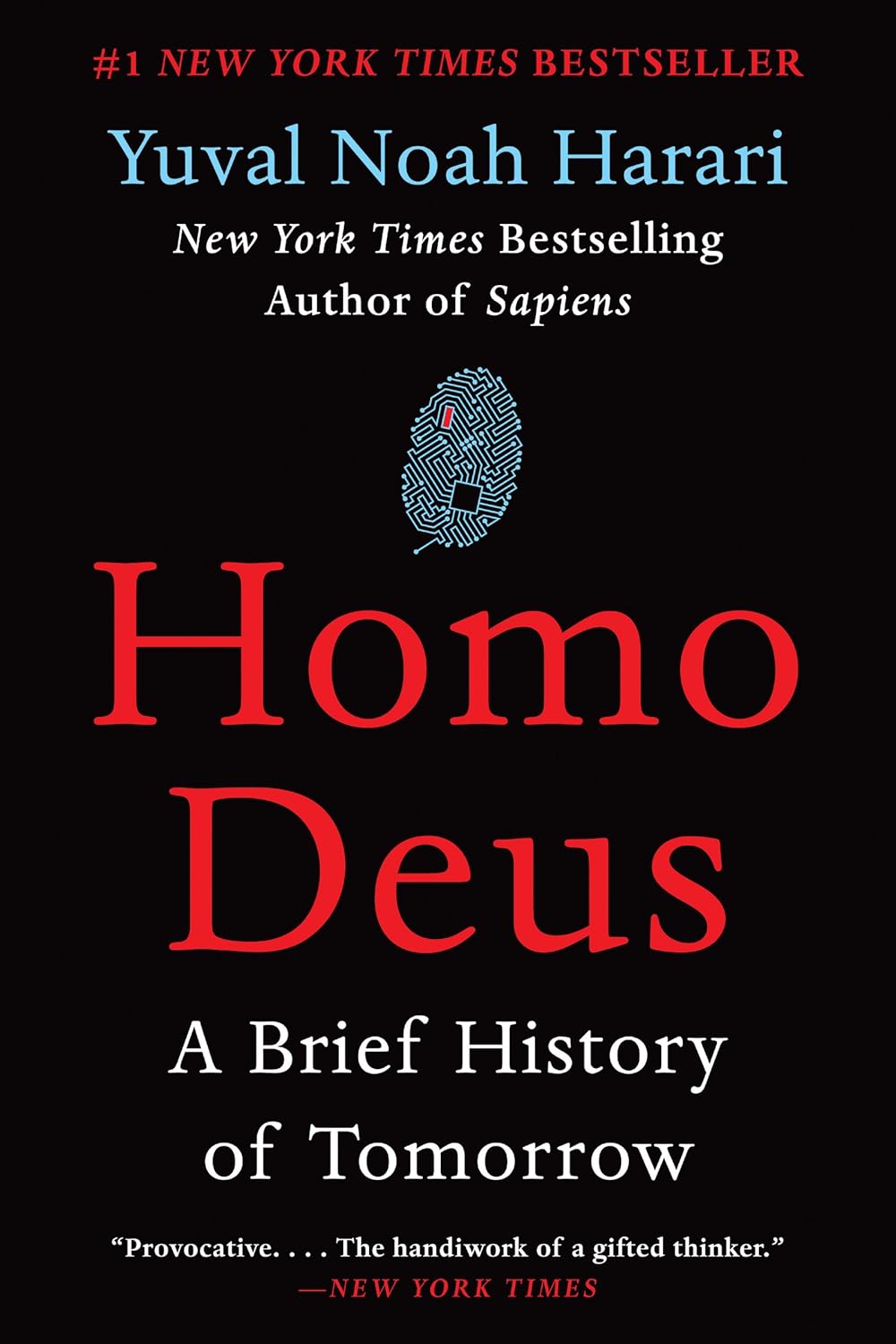
Homo Deus: A Brief History of Tomorrow
by Yuval Noah Harari
What this book is, and who it's for
Harari's sequel to Sapiens turns the lens from the past 200,000 years to the next two centuries. The opening claim: humanity has largely solved hunger, plague, and war as existential threats — so what becomes the species's project next? Harari's candidates are immortality, happiness, and divinity, pursued through data, biotech, and algorithm. The book is most interesting when it asks the uncomfortable question that the optimist version of futurism avoids: if humans stop being the most useful information-processing systems on Earth, what claim do we have on the systems that replace us? Read this for the future-stakes context most non-fiction skips.
How to read this book. Each chapter below is a ~30-second summary — the core insight, no filler. Open the chapters that grab you. If the book resonates, buy the full edition on Amazon (link at bottom). Affiliate-disclosed, geo-redirected to your local Amazon (amazon.nl, amazon.de, amazon.co.uk, etc.).
Chapters
- Chapter 1The New Human Agenda0.5 min
- Chapter 2The Anthropocene0.5 min
- Chapter 3The Human Spark0.5 min
- Chapter 4The Storytellers0.5 min
- Chapter 5The Odd Couple0.5 min
- Chapter 6The Modern Covenant0.5 min
- Chapter 7The Humanist Revolution0.5 min
- Chapter 8The Time Bomb in the Laboratory0.5 min
- Chapter 9The Great Decoupling0.5 min
- Chapter 10The Ocean of Consciousness0.5 min
- Chapter 11The Data Religion0.5 min
Closing & reference
Homo Deus pairs well with
A single book is an argument. A stack is a curriculum. Homo Deus appears in this curated reading path — each pairs it with 3 other books that sharpen its ideas, in a suggested reading order.
From Read Stacks · Learn
How to get more out of this book
Two short essays on the meta-skill — what chapter summaries actually preserve, and the six retention techniques that decide whether what you read here is still useful six months from now.
- Are book summaries actually useful, or am I just cheating?
Chapter summaries are a navigation tool, not a substitute. Used right, they help you read more books fully — by helping you avoid the wrong ones. Used wrong, they're a comfort blanket that lets you feel like you're reading without engaging with the material.
6 min read
- I read a lot of books but can't remember anything. What works?
Forgetting most of what you read is normal, not a personal failing — your brain wasn't designed to retain prose at the rate modern readers consume it. The practices that DO work share one thing: they force you to USE the material instead of just consuming it. Six specific techniques, each tested across decades.
7 min read
Want one curated stack a week in your inbox? Subscribe to the free weekly stack →