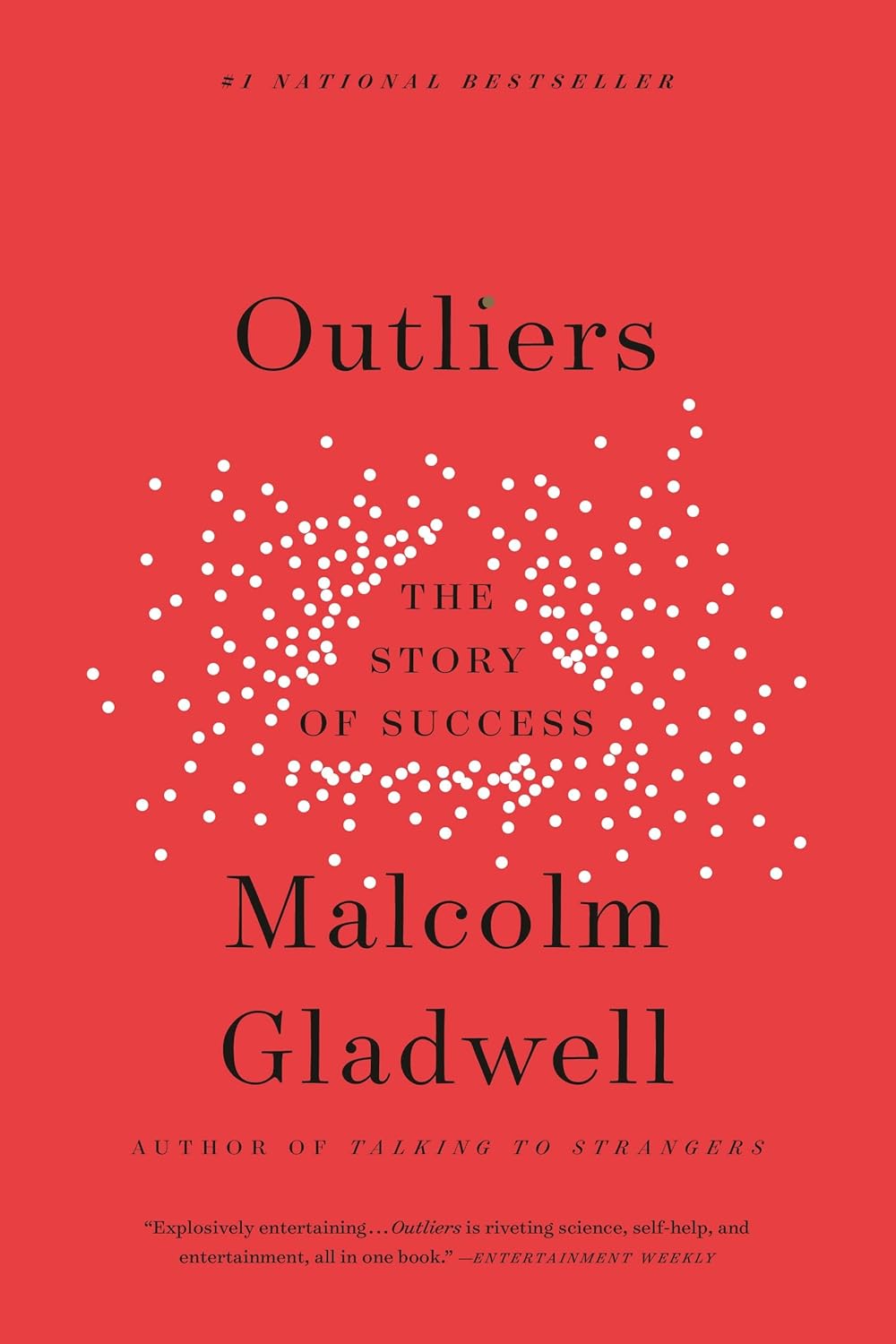
Outliers: The Story of Success
by Malcolm Gladwell
What this book is, and who it's for
Malcolm Gladwell's 2008 book demolishes the myth of pure individual talent by showing that success at the elite level is consistently — and uncomfortably — the visible top of a stack of cultural, generational, and circumstantial advantages. The 10,000-hours rule from this book got most of the attention, but the more durable argument is the broader pattern: when you ask 'why did this person succeed,' you usually find an answer in the question 'when and where were they born, and who taught them.' Read this if you've ever felt the impulse to attribute success to character — and want a more accurate model.
How to read this book. Each chapter below is a ~30-second summary — the core insight, no filler. Open the chapters that grab you. If the book resonates, buy the full edition on Amazon (link at bottom). Affiliate-disclosed, geo-redirected to your local Amazon (amazon.nl, amazon.de, amazon.co.uk, etc.).
Opening
Chapters
- Chapter 1The Matthew Effect0.5 min
- Chapter 2The 10,000-Hour Rule0.5 min
- Chapter 3The Trouble with Geniuses, Part 10.5 min
- Chapter 4The Trouble with Geniuses, Part 20.5 min
- Chapter 5The Three Lessons of Joe Flom0.5 min
- Chapter 6Harlan, Kentucky0.5 min
- Chapter 7The Ethnic Theory of Plane Crashes0.5 min
- Chapter 8Rice Paddies and Math Tests0.5 min
- Chapter 9Marita’s Bargain0.5 min
Closing & reference
Outliers pairs well with
A single book is an argument. A stack is a curriculum. Outliers appears in this curated reading path — each pairs it with 3 other books that sharpen its ideas, in a suggested reading order.
From Read Stacks · Learn
How to get more out of this book
Two short essays on the meta-skill — what chapter summaries actually preserve, and the six retention techniques that decide whether what you read here is still useful six months from now.
- Are book summaries actually useful, or am I just cheating?
Chapter summaries are a navigation tool, not a substitute. Used right, they help you read more books fully — by helping you avoid the wrong ones. Used wrong, they're a comfort blanket that lets you feel like you're reading without engaging with the material.
6 min read
- I read a lot of books but can't remember anything. What works?
Forgetting most of what you read is normal, not a personal failing — your brain wasn't designed to retain prose at the rate modern readers consume it. The practices that DO work share one thing: they force you to USE the material instead of just consuming it. Six specific techniques, each tested across decades.
7 min read
Want one curated stack a week in your inbox? Subscribe to the free weekly stack →